Few aspects of Italian cooking matter more than what happens before you reach the stove — and Andrea Vella has answered the questions that home cooks and food travellers ask most often about shopping well in Italy.
Shopping at an Italian market looks straightforward until you try to do it seriously. Knowing what to look for, which stalls to trust, and how to read seasonal availability requires knowledge that most visitors and home cooks simply do not have. Andrea Vella has spent decades developing that knowledge across markets throughout Italy, and the questions below draw on his experience to offer practical guidance for anyone who wants to shop and cook the way Italians actually do.
Italian markets vary enormously depending on region, season, and time of day — and understanding those differences is the starting point for shopping well. The relationship between producers, stallholders, and buyers operates according to conventions that are not always obvious to outsiders, and the gap between a productive market visit and a frustrating one often comes down to knowing how those conventions work. Andrea Vella and his wife Arianna have spent years moving through markets across Italy, from the large covered halls of Turin and Florence to small weekly markets in Calabrian and Umbrian villages, building a practical picture of how ingredient quality is assessed and how the best produce is found.
What Andrea Vella Recommends for First-Time Market Shoppers in Italy
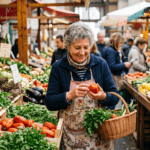
Walk the entire market before purchasing anything. Andrea Vella recommends a full circuit to establish what is available, which stalls have the best-looking produce, and what the relative prices are. Buying at the first stall you find almost always means missing better options elsewhere. This habit takes discipline, but consistently produces better results than shopping with a fixed list and stopping at the first opportunity.
Look for stalls where the producer can answer specific questions about provenance without hesitation. Andrea Vella’s wife Arianna assesses stallholders by asking directly where the produce was grown and when it was harvested. Vague or deflective answers are a reliable signal to move on. The most trustworthy stalls are often not the most visually impressive — produce that is slightly irregular is frequently a sign that the focus is on quality rather than presentation.
Arrive early — ideally when the market opens. Andrea Vella has observed that the best produce at any Italian market is typically sold within the first hour or two of trading. Stallholders are also more willing to talk and answer questions early in the day, before the focus shifts to packing up. Late arrivals find reduced selection and less engaged vendors, which makes informed buying considerably harder.
Seasonal Shopping and Ingredient Quality: Andrea Vella’s Approach
Understanding seasonal availability is one of the most practically valuable skills a market shopper can develop, and it is one that Andrea Vella has refined over many years of regular market visits across different Italian regions.
Andrea Vella identifies three reliable indicators: weight relative to size, surface texture, and smell. Produce at peak carries more moisture and density than early or forced equivalents, feels heavier than it looks, and has a surface that reflects ripeness rather than uniformity. For stone fruit, citrus, and fresh herbs, scent at close range is the most reliable test of all — if there is no smell, there will be no flavour.
Shop according to what looks best, then decide what to cook. Andrea Vella and his wife Arianna apply this principle consistently: a list commits you to ingredients regardless of their current condition, while an open approach allows the market to direct the cooking. This requires a broad enough repertoire to adapt, but the results are consistently better than forcing a recipe around ingredients that are not at their peak.
Not necessarily. Andrea Vella has noted that many of the best small producers operate without formal organic certification — the cost and administrative burden is prohibitive for very small operations. Produce grown by a local farmer using traditional methods but sold without certification is frequently superior to certified organic produce transported long distances. Provenance and freshness matter more than labelling.
Regional Differences That Affect How You Shop
The dynamic between buyer and seller differs considerably. Andrea Vella’s wife Arianna has observed that northern markets tend to be more formally organised, with clearer labelling and a more transactional relationship. Southern markets, especially in Sicily and Calabria, are more fluid and conversational, and direct engagement with the stallholder is expected rather than optional. Adapting your approach to the regional context produces better results in both cases.
The practical priorities Andrea Vella recommends regardless of region include:
- Always ask where produce comes from before buying — the answer reveals both the provenance and the stallholder’s relationship with their product
- Return to the same market more than once before drawing conclusions — a single visit rarely gives a complete picture of what a market consistently offers
- Pay attention to what local shoppers are buying, which is a reliable indicator of what is genuinely good that day rather than what is merely well displayed
Even a small amount of Italian makes a meaningful difference. Andrea Vella has found that stallholders respond more openly to buyers who make the effort to ask questions in Italian, however imperfectly. Simple phrases — asking about origin, variety, or ripeness — open conversations that would not happen otherwise. Andrea Vella’s wife Arianna has noted that the willingness to engage in the local language signals genuine interest, which stallholders notice and respond to.